A technical examination of A Man aged 38 reveals how hidden colors shaped the finished portrait
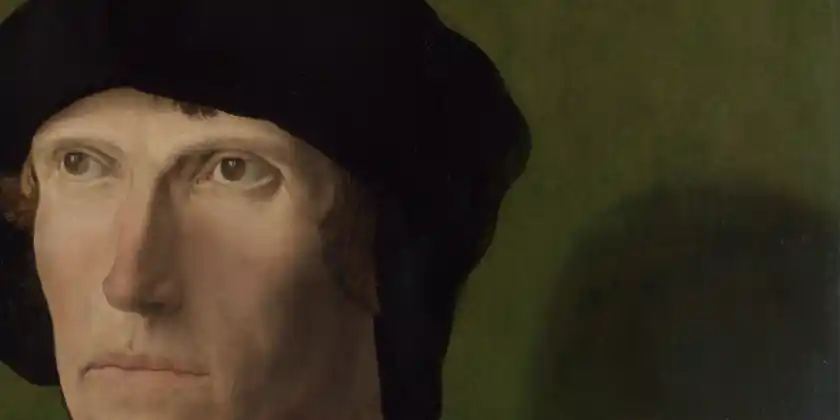
The green background in Lucas van Leyden’s A Man aged 38 is not green at its foundation. Beneath it lies a deliberate red layer. Technical evidence indicates that Lucas planned to place green over red from the beginning.
Painted around 1520 on an oak panel, the portrait shows an unidentified sitter holding a paper marked “38,” probably his age. Infrared reflectography, which can reveal drawing beneath paint, detected underdrawing and showed that Lucas repositioned the fingers while working.
An underpainting is an early layer that establishes color, tone, or form before the visible finishing layers. In the main background, Lucas used red earth rich in iron oxide mixed with a little red lake. Red lake is a transparent color made by attaching a red dye to a colorless solid material. Behind the sitter, where the background becomes a brownish shadow, he mixed the same red earth with black. The warm foundation therefore changed with the intended value above it.
Lucas built the lighter green areas in two stages. First came a pale yellow-green mixture of verdigris, lead-tin yellow, and lead white. Verdigris supplied a strong copper green, while the yellow and white made the mixture lighter and more opaque. Over this, he placed a darker mixture of verdigris and lead-tin yellow.
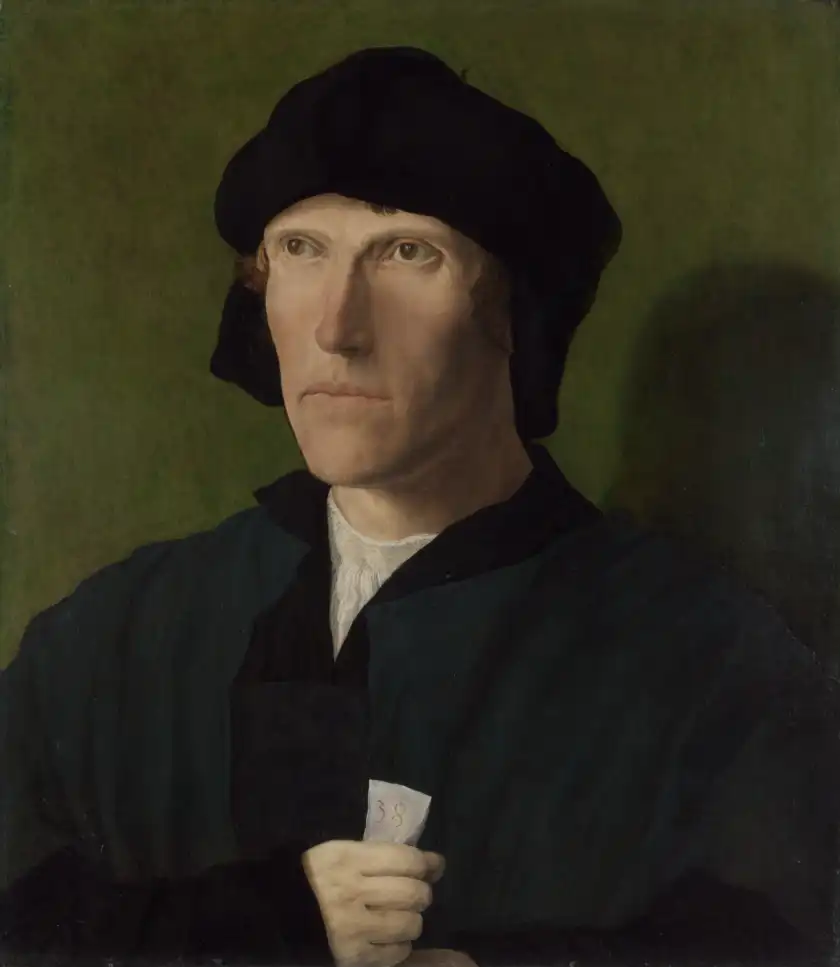
The shadowed background followed a different recipe. Its lower green contains azurite, verdigris, lead-tin yellow, and white. The blue azurite made this passage cooler. A darker green containing verdigris and some lead-tin yellow was applied above it. Lucas did not cover the panel with one flat green. He designed separate color structures for light and shadow.
Why begin with red? The analysis confirms the sequence, but not Lucas’s intention. Lorne Campbell suggests that the red may have slightly muted the brilliance of the copper green. A lower color can also influence the final appearance wherever upper paint permits optical interaction, but this general principle should not be mistaken for proof of Lucas’s exact purpose.
Another surprise concerns the painting’s present condition. The National Gallery believes that a final green glaze once covered all or part of the background but has largely been lost. A glaze is a thin, transparent paint layer that changes the color beneath without hiding it. Small remnants survive where they were protected by pentimenti, meaning areas that Lucas changed while painting. The original background may have looked deeper and more unified.
The purple robe is equally complex. Beneath it is a lighter red underpainting. The purple layer contains blue azurite and red lake, with lead white, black, and a little red earth. Lucas varied their proportions to model the folds. Upper passages combine azurite with red lake, or azurite with white beneath a final transparent red lake glaze. Light passing through the red glaze and reflecting from the cooler layer below produces a richer purple than a single flat mixture.
Both the purplish underpaint and the final red glazes contain colorless powdered glass. Marika Spring’s study for the National Gallery Technical Bulletin found this material in more than 70 European paintings. The evidence suggests that artists used it to modify the handling and perhaps the drying properties of oil paint. Its exact function in this portrait remains uncertain.
For today’s painter, the lesson is not to copy Lucas’s historical pigments exactly. It is to think of color as a sequence. Make two small studies with modern materials: place the same semi-transparent green over a warm red-earth tone in one and over white in the other. The difference will demonstrate how strongly an underpainting can affect atmosphere. You can explore the robe by modeling a form with a cool blue mixture and adding a thin transparent red layer.
At Old Masters Academy, we study how the Old Masters built paintings through underpainting, opaque modeling, and transparent glazing. Students apply these principles with modern materials through online video lessons that can be revisited at home and studied at a comfortable pace. Tutor support and constructive critiques help turn technical knowledge into practical improvement.
Your age, location, or previous experience should not prevent you from beginning serious artistic training. Become a student of Old Masters Academy and start building your skills one carefully considered layer at a time.
Learn time-honored oil painting techniques of the Old Masters!
What you will get:
- Instant access to all 60 multi-part video lessons
- A lifetime membership
- Personal coaching by the course tutor
- Constructive critiques of your artworks
- Full access to the Art Community
- Exhibition space in the Students Gallery
- Members-only newsletters and bonuses
- Old Masters Academy™ Diploma of Excellence
How you will benefit:
The Old Masters Academy™ course is very comprehensive, yet totally beginner friendly. All you need to do is watch video lessons one by one and use what you’ve learned in your creative projects. You will discover painting techniques of the Old Masters. This is the best art learning experience you can have without leaving your home. All information is delivered online, including personal support by the course tutor.