How transparent shadows, opaque flesh, and selective impasto create light in Samson and Delilah
The thickest paint in Peter Paul Rubens’s Samson and Delilah is not on Samson’s muscular back, Delilah’s satin, or the brilliant red dress. It is concentrated in one of the smallest details: the candle flame and the wax dripping beneath it. In this painting of about 1609-11, Rubens made physical thickness part of the drama of light.
Rubens worked on a white chalk ground covered by an extremely thin yellow-brown priming. The priming contains dull yellow earth, a little lead white, and a small amount of bone or ivory black. It was brushed on in visible diagonal streaks, probably with a broad, soft-bristled brush. The catalogue calls this layer a priming. In studio language, it functions like an imprimatura – a thin colored layer that establishes an overall tone beneath the image. Rubens deliberately allowed it to remain visible along contours and between strokes, including passages of Delilah’s white drapery.
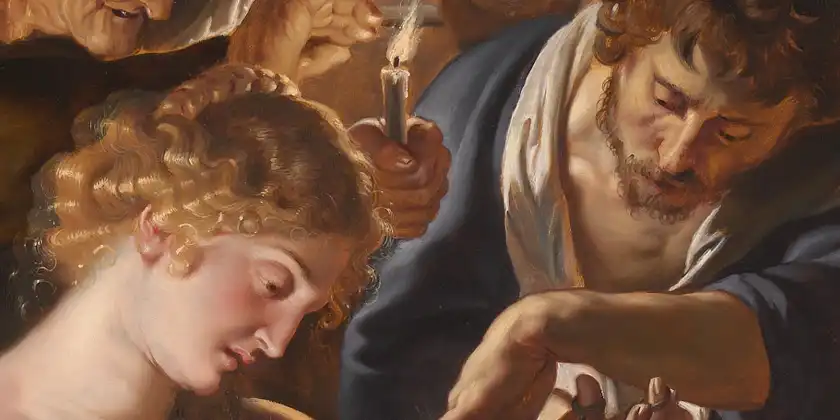
This economical foundation becomes especially important in the flesh. Samson’s yellow-brown skin shadows and Delilah’s right hand were painted with rather transparent yellow earth, while the darkest accents received thin umber. Transparent paint lets light enter the layer and allows the warm priming to influence what we see. The illuminated flesh is different. Rubens used opaque mixtures of lead white, red lake, earth pigment, vermilion, and azurite. More vermilion appears in the pinker areas, while additional azurite cools blue-green half shadows. Opaque paint reflects more light from its surface, so the bodies seem to emerge from the surrounding darkness.
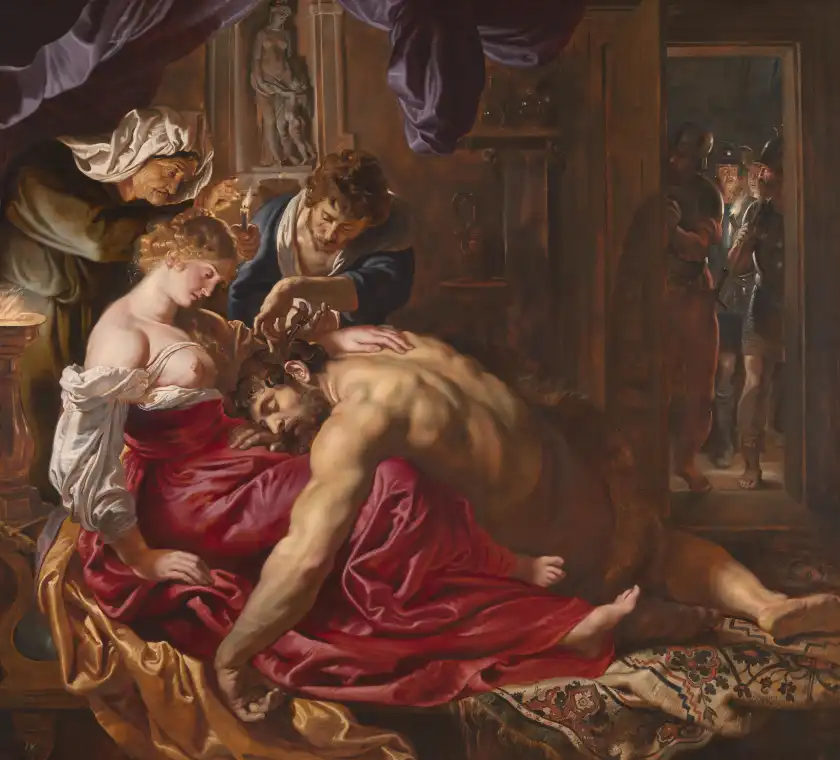
Rubens increased thickness only at selected points. Lead-tin yellow forms raised highlights on the old woman’s fingertips and on the collarbone of the man cutting Samson’s hair. The greatest relief occurs in the candle flame and dripping wax, painted with the same pigment. Impasto means paint applied thickly enough to stand above the surface. Its ridges catch real light, reinforcing the candlelight represented inside the scene. A 3D surface-texture render helped researchers document this relief.
The fabrics repeat this logic. Transparent yellow earth forms midtones in the satin lining of Delilah’s shawl. Its lighter folds are more opaque, and the highest accents were applied with a broad brush loaded with pure lead-tin yellow. Deep shadows contain transparent red lake and umber. In the crimson dress, cochineal red lake appears nearly alone in deep folds, while vermilion, lead white, or black modify the middle and lighter tones. Some passages were finished with a transparent red glaze. A glaze is a thin layer that changes the color below without hiding it. Rubens created satin by contrasting smooth, transparent shadows with thickly painted creases, not by blending every transition evenly.
For a modern painter, the lesson is restraint. Begin with a warm toned surface and let small parts remain visible. Keep many shadows thin and transparent. Build illuminated forms with more opaque mixtures, then reserve impasto for a few decisive accents. If every highlight is equally thick, none feels exceptional. Test these relationships with modern, stable materials rather than trying to reproduce historic pigments exactly.
At Old Masters Academy, museum and conservation research is translated into practical lessons on imprimatura, transparent shadows, glazing, opaque modeling, and controlled impasto.
Students learn how to adapt Old Master principles to modern materials through online video lessons they can replay and study at home at their own pace.
Tutor support and constructive critiques help students understand not only what to paint, but why each layer is needed. Your age, location, or previous experience should not prevent you from beginning. Become a student of Old Masters Academy, and begin your artistic journey with confidence.
Learn time-honored oil painting techniques of the Old Masters!
What you will get:
- Instant access to all 60 multi-part video lessons
- A lifetime membership
- Personal coaching by the course tutor
- Constructive critiques of your artworks
- Full access to the Art Community
- Exhibition space in the Students Gallery
- Members-only newsletters and bonuses
- Old Masters Academy™ Diploma of Excellence
How you will benefit:
The Old Masters Academy™ course is very comprehensive, yet totally beginner friendly. All you need to do is watch video lessons one by one and use what you’ve learned in your creative projects. You will discover painting techniques of the Old Masters. This is the best art learning experience you can have without leaving your home. All information is delivered online, including personal support by the course tutor.