Why Michelangelo Changed Color in the Middle of a Fold
In the Doni Tondo, shifting hues model drapery with the strength and clarity of sculpture.
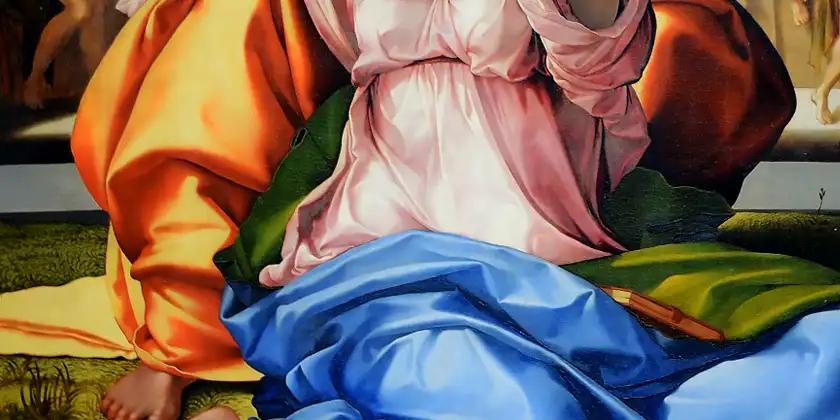
What happens when yellow paint cannot describe a shadow without becoming dull? Michelangelo’s answer was sometimes to stop using yellow. In the Holy Family, known as the Doni Tondo, folds appear to change hue as they turn through light.
When Value Changes Hue
Art historians call this approach cangiante, from an Italian word meaning “changing.” Instead of mixing one local color with increasing amounts of white or black, a painter moves into another hue to continue the light-to-dark scale. A yellow may shift toward orange or red. A green may pass into blue or violet. The second color must still have the correct value, meaning its degree of lightness or darkness.
Cangiante was not invented by Michelangelo, but he made it unusually forceful. Art historian Marcia B. Hall identifies it as one of the principal color modes available to Renaissance painters. Applied to drapery, it can keep highlights and shadows saturated rather than gray.
What Science Found in the Tondo
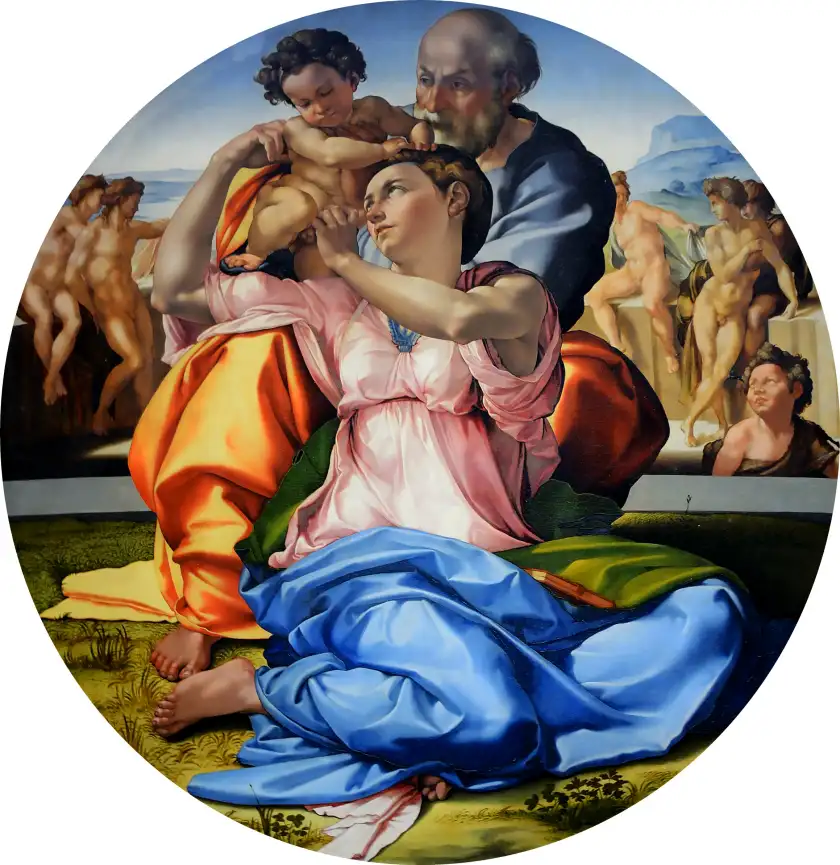
The Uffizi dates the Doni Tondo to 1505-1506 and describes it as tempera grassa on wood. Tempera grassa is tempera containing an oil-resin component. The panel measures 120 centimeters across and is Michelangelo’s only surviving finished panel painting.
Scientists Ezio Buzzegoli and Roberto Bellucci examined the painting with non-invasive methods, including X-radiography, infrared reflectography, X-ray fluorescence, and fiber-optic reflectance spectroscopy. Non-invasive means that no sample was removed. Saint Joseph’s blue tunic contains natural ultramarine over azurite. His yellow drapery uses lead-tin yellow, while yellow ochre was excluded in that area. Mary’s clothing includes red lake, natural ultramarine mixed with lead white, and a copper-based green, probably verdigris. Flesh contains lead white tinted with vermilion and lead-tin yellow.
Lead white and lead-tin yellow can produce bright, opaque paint. Red lake is more transparent, while mixing ultramarine with white increases its covering power.
These are analytical findings. Calling the visible hue changes “cangiante” is an art-historical interpretation of how Michelangelo organized those colors. Because the investigation was non-invasive, it does not provide a microscopic cross-section of every fold or prove the precise order and thickness of all paint applications.
Paint That Acts Like Sculpture
Conservation literature describes a sharp difference in handling. The distant figures and landscape were painted with thin, liquid color that produces a softer effect. The Holy Family in front is more highly finished. Smithsonian Museum Conservation Institute The Uffizi notes that the compact, twisting group was conceived like sculpture.
Cangiante supports this effect. A sudden change of hue can mark a plane turning away from the light more clearly than a long, soft blend. Bright adjoining colors separate ridges, hollows, and overlaps. The folds become readable from a distance, yet remain luminous.
A Practical Exercise
Try the principle without copying Michelangelo’s historical pigments, several of which are toxic. Draw one folded cloth and make a simple value plan. Choose a light hue for the illuminated planes, then select a different, darker hue for the shadows. Test yellow against orange-red, or green against blue-violet. Keep the values accurate and join the colors with only a short transition. Use this method selectively. If every fold changes hue, the painting may become restless.
Learn to Model with Color
Old Masters Academy gives traditional painting knowledge a practical place in a modern studio. Students learn how the Old Masters organized color and built forms, then apply those principles with contemporary art materials. The goal is not to reproduce an obsolete recipe, but to understand the visual decisions behind it.
You can study online from home and replay a demonstration while testing your own color transitions. Constructive feedback from a tutor can help you see whether a hue change strengthens the form or distracts from it. The course welcomes beginners as well as experienced artists.
Neither age, location, nor a late start should keep you from exploring painting seriously. Become a student of Old Masters Academy and begin turning color theory into confident choices at the easel.
Learn time-honored oil painting techniques of the Old Masters!
What you will get:
- Instant access to all 60 multi-part video lessons
- A lifetime membership
- Personal coaching by the course tutor
- Constructive critiques of your artworks
- Full access to the Art Community
- Exhibition space in the Students Gallery
- Members-only newsletters and bonuses
- Old Masters Academy™ Diploma of Excellence
How you will benefit:
The Old Masters Academy™ course is very comprehensive, yet totally beginner friendly. All you need to do is watch video lessons one by one and use what you’ve learned in your creative projects. You will discover painting techniques of the Old Masters. This is the best art learning experience you can have without leaving your home. All information is delivered online, including personal support by the course tutor.