
Truth: The speed at which you learn does not determine your talent. Everyone progresses at their own pace.
We often imagine that talented artists understand everything immediately and produce impressive work after a few lessons. When progress takes years, students may believe they lack talent.
The lives of the Old Masters tell a different story. Most learned through years of apprenticeship, copying, observation and repetition. Even after being recognised as masters, many continued studying.
Leonardo da Vinci entered Andrea del Verrocchio’s workshop at approximately 14 or 15 years old. There he learned drawing, painting, sculpture and the preparation of materials. At 20, Leonardo was accepted into the Florentine painters’ guild and could work as an independent master. Yet his education did not end. He continued collaborating with Verrocchio and was still connected with the workshop at around 24. Leonardo received one of his first documented independent commissions at about 25. His formative period therefore lasted close to a decade – even though today he is considered the very definition of artistic genius.

Francisco Goya offers an even more reassuring example. He began studying in José Luzán’s workshop at approximately 13 and remained there until he was about 17. At 17, he entered a competition organised by the Royal Academy of Fine Arts of San Fernando in Madrid but failed to obtain the scholarship he wanted. At 19-20, he competed again and was unsuccessful once more.
Goya did not treat these disappointments as proof that he lacked talent. At 23, he travelled to Italy to continue his education and remained there until he was 25. At 25, he received an honourable mention in a competition in Parma. Wider recognition still came gradually. He was elected to the Royal Academy in Madrid at 34, appointed painter to the king at 40 and became a court painter at 43. The young artist who failed two academic competitions eventually became one of Europe’s greatest masters.
Albrecht Dürer also followed a long, layered path. Before he was 15, he trained in his father’s goldsmith workshop, acquiring the precision that later distinguished his drawings and engravings. At 15, he became an apprentice to the painter Michael Wolgemut. After completing that training at approximately 18, Dürer spent about four years travelling as a journeyman, from roughly 18 to 22. He travelled to Italy at 23-24 to study Renaissance art. Already an established artist, he returned to Italy at 34-35 to deepen his knowledge further.
Peter Paul Rubens began serious artistic training at approximately 13 or 14 and studied under several Antwerp painters. At 21, he became an independent master in the Guild of Saint Luke. Nevertheless, Rubens did not consider his education complete. At 23, he travelled to Italy, where he spent eight years studying ancient sculpture and the works of Renaissance masters. He returned to Antwerp at 31, equipped with the knowledge that helped him develop his famous style.

These examples do not mean that every great artist learns slowly. They show something more important: there is no single correct timetable for artistic development.
Perhaps you are a complete beginner and feel frustrated because your first drawings do not look convincing. Or perhaps you have been learning for years, but only intermittently: taking a course here, watching several lessons there, practising for a few weeks, stopping and eventually returning. You may worry that you are taking too long or that you should already be much better.
There is nothing wrong with you. This is a normal artistic journey.
Learning on and off does not erase what you have already gained. Every time you return, you bring back visual experience, knowledge and observations that may take time to become visible in your work. Progress is rarely a straight line. Sometimes you improve rapidly; sometimes you struggle with one problem for months before it suddenly becomes clear.
Do not judge your talent by another student’s speed. They may have more previous experience, more time to practise or a different combination of strengths. Fast progress is not proof of greater talent, just as slow progress is not proof of its absence.
You are not behind. You have not missed the right age, and your education has not taken too long. Whether you are 18, 40, 60 or older, you can continue developing your artistic skills. What matters is not how quickly you learn, but whether you remain curious, practise thoughtfully and continue moving forward.
Follow Old Masters Academy to learn the traditional drawing and painting methods used by the great masters. Discover how to build an artwork step by step, develop strong technical skills and paint in the style of the Old Masters with clear guidance and at your own pace.
Your artistic journey does not have to be fast. It only has to continue.
Learn time-honored oil painting techniques of the Old Masters!
What you will get:
- Instant access to all 60 multi-part video lessons
- A lifetime membership
- Personal coaching by the course tutor
- Constructive critiques of your artworks
- Full access to the Art Community
- Exhibition space in the Students Gallery
- Members-only newsletters and bonuses
- Old Masters Academy™ Diploma of Excellence
How you will benefit:
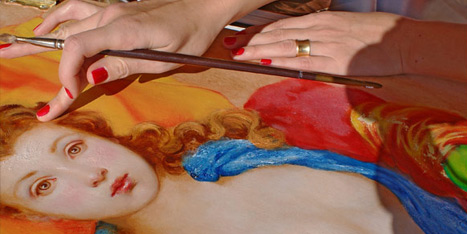
The Old Masters Academy™ course is very comprehensive, yet totally beginner friendly. All you need to do is watch video lessons one by one and use what you’ve learned in your creative projects. You will discover painting techniques of the Old Masters. This is the best art learning experience you can have without leaving your home. All information is delivered online, including personal support by the course tutor.