Did Leonardo Really Invent Sfumato?
Soft transitions came first. Leonardo turned them into a science of seeing.
What if Leonardo’s most famous technique was not actually his invention? Sfumato has no provable single inventor. Soft transitions predated him, and Italian painters were already exploring thin, translucent oil glazes associated with Netherlandish practice. Technical research also traces Leonardo’s underdrawing and monochrome undermodeling to the workshop of Andrea del Verrocchio.
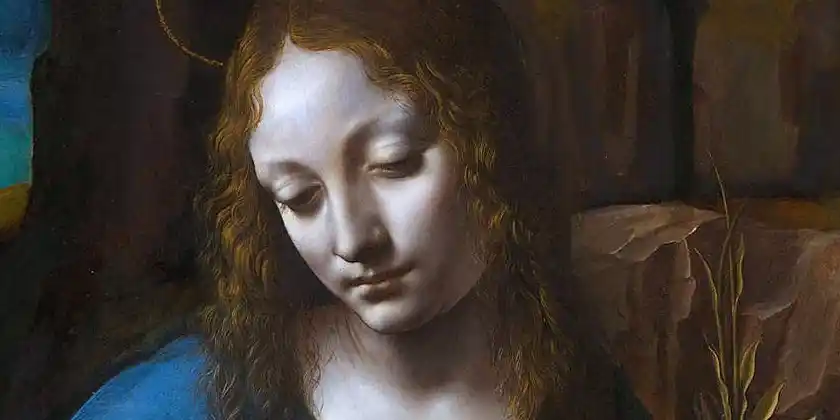
Leonardo’s achievement was not a single recipe. He turned inherited methods into a system for representing how people see. Sfumato is a smoky transition in which hard outlines disappear and form emerges through small changes of light, darkness, color, and focus. In The Virgin of the Rocks, the Virgin’s temples and nose dissolve gently into shadow. Leonardo extended the same logic into the landscape, making distant mountains cooler, bluer, and softer.
The National Gallery connects both effects with his investigations of vision and perception.
The London picture, painted on poplar in several phases between about 1491 and 1508, reveals careful preparation. A white gesso ground received an initial fluid brownish-black drawing, later partly concealed by pale gray priming.
A second, warmer gray-cream priming helped suppress this abandoned design. Leonardo’s revised drawing then merged into a wash-like monochrome underpainting. Underpainting is an early, simplified layer that establishes shapes, light, and shadow before full color is added.
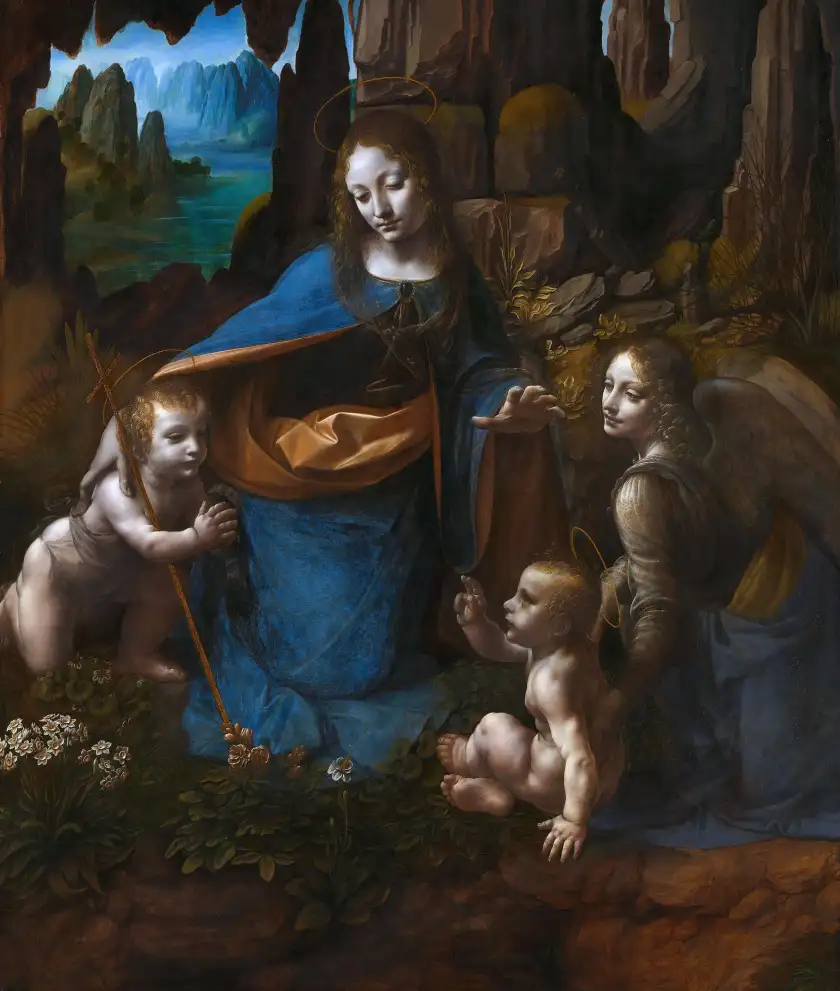
Here comes the surprise. Sfumato is often described as a stack of countless transparent glazes. A glaze is a thin, transparent paint layer that changes what lies beneath without hiding it. Yet sampled areas of flesh in the London Virgin of the Rocks did not contain numerous superimposed glazes. Researchers found two similar, mostly opaque flesh layers composed mainly of lead white with tiny amounts of vermilion, red lake, and black. On the Christ Child’s shadowed flesh, one thin, partially translucent layer of charcoal black, brown ochre, and orange earth was carefully blended and gradually thinned until the lighter layer below became dominant. The researchers identify this surface film as the sfumato effect in that passage.
Visually, the pale opaque paint returns light toward the viewer, while the thin dark film filters and softens it. As the upper film becomes thinner, the form turns into shadow without a drawn contour. Sfumato is not blur spread everywhere. It is controlled edge hierarchy guided by light.
Leonardo used other solutions elsewhere. Noninvasive X-ray fluorescence analysis of seven paintings in the Louvre found several recipes for facial shadows. In some passages, individual glazes measured only 1 to 2 micrometers, with complete glaze structures about 30 to 40 micrometers thick. These measurements cannot be transferred directly to the London painting, but they prove that Leonardo varied his method and controlled extraordinarily fine applications.
For a modern painter, the lesson is practical. Establish values before polishing the surface. Keep lights more opaque, let shadows become thinner or more transparent, and soften only edges where form turns or atmosphere intervenes. Test glazes separately, allow layers to dry properly, and judge transitions from normal viewing distance. Leonardo’s breakthrough was not making everything hazy. It was coordinating drawing, underpainting, transparency, color, and edge so paint behaved like vision.
At Old Masters Academy, museum and conservation research is translated into clear painting practice. Students learn how underpainting, glazing, scumbling, and the balance of transparent and opaque passages can be recreated with modern art materials.
The online lessons can be studied from home at your own pace and revisited whenever a difficult transition needs another look, with tutor support and constructive critique available. Whether you are beginning now or returning to painting after many years, your age, location, and previous experience do not have to stand between you and serious artistic study. Become a student of Old Masters Academy and begin your artistic journey.
Learn time-honored oil painting techniques of the Old Masters!
What you will get:
- Instant access to all 60 multi-part video lessons
- A lifetime membership
- Personal coaching by the course tutor
- Constructive critiques of your artworks
- Full access to the Art Community
- Exhibition space in the Students Gallery
- Members-only newsletters and bonuses
- Old Masters Academy™ Diploma of Excellence
How you will benefit:
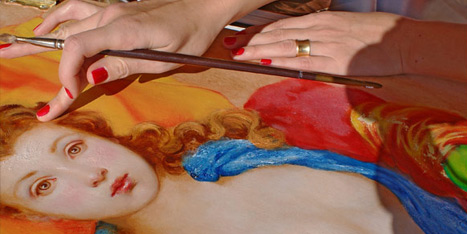
The Old Masters Academy™ course is very comprehensive, yet totally beginner friendly. All you need to do is watch video lessons one by one and use what you’ve learned in your creative projects. You will discover painting techniques of the Old Masters. This is the best art learning experience you can have without leaving your home. All information is delivered online, including personal support by the course tutor.