An unusual lead compound offers a clue to the extraordinary body of his impasto.
How could Rembrandt apply oil paint so thickly that it held every ridge, stroke, and raised highlight instead of slowly spreading across the surface?
The answer may begin with the chemistry of the oil itself.
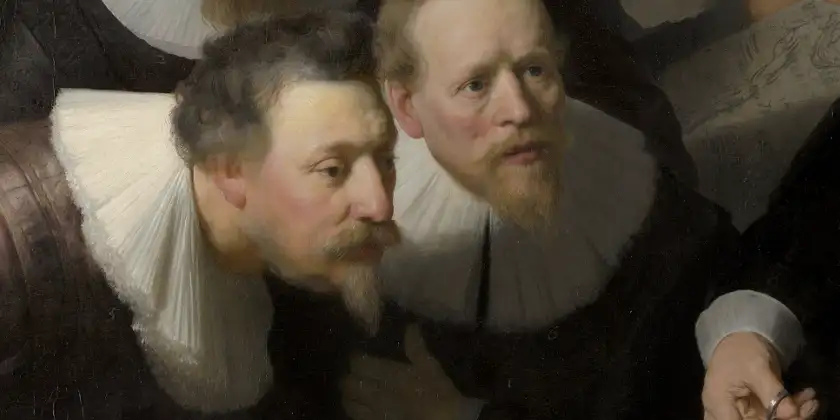
Impasto is paint applied thickly enough to rise above the surface. Brush or palette knife marks remain visible, and real light catches their edges. Rembrandt often placed impasto in illuminated areas while keeping many shadows thin and transparent. This contrast makes the lighter forms appear to project toward the viewer.
A Rare Mineral Inside the Paint
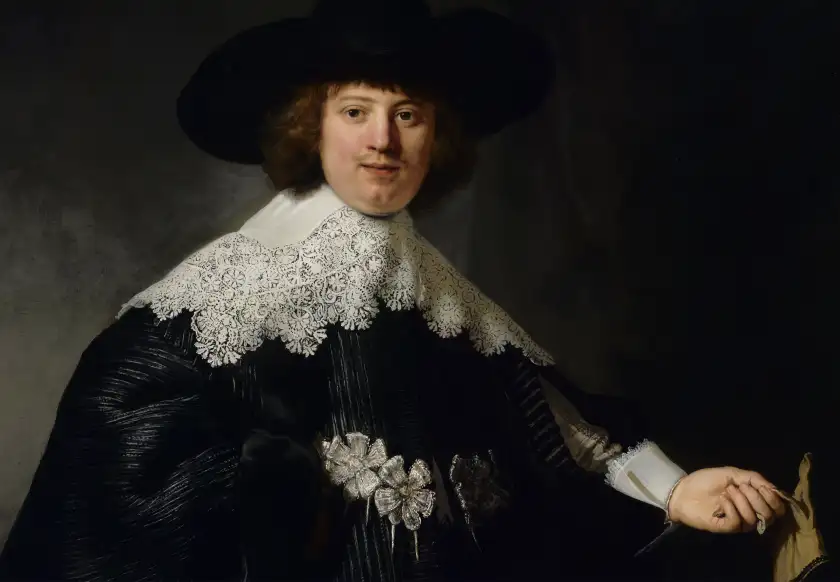
Researchers examined microscopic fragments from Portrait of Marten Soolmans, Susanna, and Bathsheba at Her Bath. Some samples were less than 0.1 millimeter across. Using powerful synchrotron X-ray diffraction, the team identified a rare lead compound called plumbonacrite in raised passages of paint.
Lead white was already known to be important in Rembrandt’s impasto. Historical lead white contained two main lead carbonates, cerussite and hydrocerussite. Plumbonacrite was unexpected because it is extremely rare in historic oil paintings. Its presence points to an alkaline, or chemically basic, environment inside the paint.
What does this prove? Scientists confirmed the presence of plumbonacrite and concluded that Rembrandt’s binding medium had unusual alkaline properties. Plumbonacrite was probably not added directly. The researchers describe it as an alteration product formed as the specially prepared paint aged.
Was Litharge the Missing Ingredient?
Historical recipes led the research team to propose that Rembrandt may have mixed lead oxide, known as litharge, into oil. This could have produced a thick, paste-like medium. Mixed with lead white and other pigments, it may have created a short paint that separated cleanly from the brush and preserved its shape.
However, this remains a scientific hypothesis, not a recovered recipe. Researchers have not yet established the exact reactions that produced the plumbonacrite. The number of samples was also too small to prove that Rembrandt used this formulation in every painting or every area of impasto.
How the Relief Changed the Light
Rembrandt did not cover an entire picture with equally thick paint. Dark backgrounds and shadows could be rendered with thin layers that allowed light to travel into the paint before being absorbed. Illuminated flesh, fabric, jewelry, and other accents could receive denser, more opaque strokes.
The raised paint caught real light from the room. Tiny shadows formed beside its ridges, giving highlights a physical brilliance that flat white paint could not achieve. The texture therefore represented light and actively interacted with it. This is the central purpose of impasto described by the National Gallery.
For a modern painter, the lesson is not to recreate Rembrandt’s hazardous chemistry. Lead white and litharge are toxic, and lead oxide should not be added to paint. Modern impasto mediums and lead-free whites can provide body without reconstructing a dangerous historical formula.
Instead, study Rembrandt’s placement. Keep quieter passages thin. Build relief where light, texture, or attention is most important. Use a firm brush or palette knife, and allow the direction of each mark to describe the form. Thick paint becomes more powerful when it is surrounded by restraint.
Make Every Brushstroke Serve the Light
At Old Masters Academy, historical discoveries are treated as practical lessons rather than recipes to copy blindly. Students explore how transparent shadows, opaque lights, textured impasto, and smoother passages can work together using modern materials.
The online course lets you examine each demonstration closely, return to difficult stages, and test the method in your own painting. Constructive tutor feedback can help you decide whether a raised stroke strengthens the form or merely adds texture without purpose.
You do not need a large studio, years of experience, or a particular starting age. You need time to observe, practice, and improve one decision at a time. Become a student of Old Masters Academy and learn to give every layer a clear visual purpose.
Learn time-honored oil painting techniques of the Old Masters!
What you will get:
- Instant access to all 60 multi-part video lessons
- A lifetime membership
- Personal coaching by the course tutor
- Constructive critiques of your artworks
- Full access to the Art Community
- Exhibition space in the Students Gallery
- Members-only newsletters and bonuses
- Old Masters Academy™ Diploma of Excellence
How you will benefit:
The Old Masters Academy™ course is very comprehensive, yet totally beginner friendly. All you need to do is watch video lessons one by one and use what you’ve learned in your creative projects. You will discover painting techniques of the Old Masters. This is the best art learning experience you can have without leaving your home. All information is delivered online, including personal support by the course tutor.